
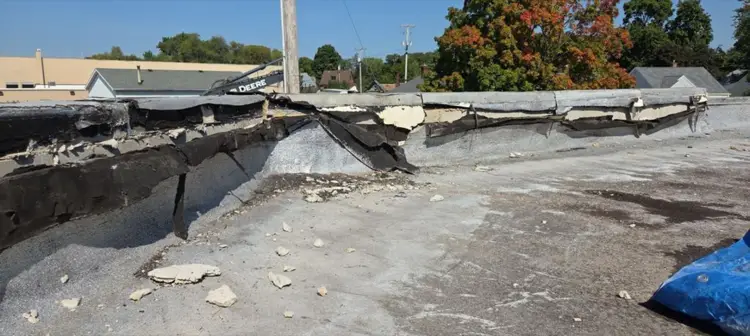
Commercial flat roofs are a smart choice for warehouses, office blocks, retail stores, and industrial buildings, but they come with high-stakes problems that demand attention. Ignoring even small issues can mean downtime, expensive fixes, and operational headaches.
Here are the most severe problems building owners face, why they matter, and exactly what to do about them.
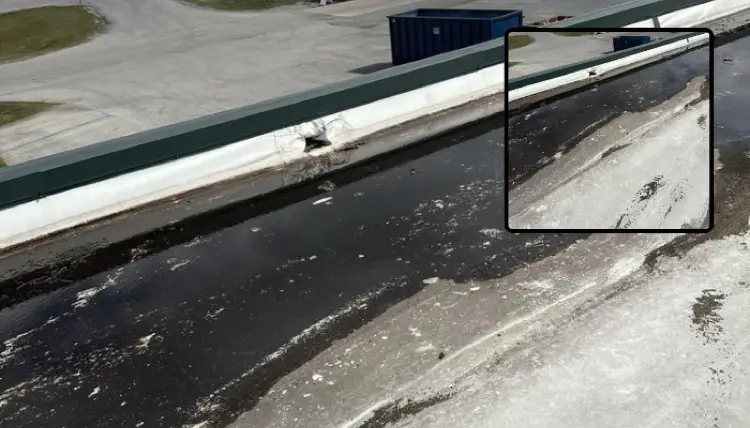
1. Extensive Ponding Water is a Problem
Commercial flat roofs barely slope – usually they have a small 0.25/12” to 2/12” slope, meaning water pools easily.
If more than 2 inches of water stand for more than 48 hours, it will deteriorate the membrane more quickly and jeopardise its longevity.

“After a good downpour, wait a day and then walk the roof. I’m looking for any ponding that’s still sitting there, clogged gutters, and penetration flashings that have started to break down.”
2. Sneaky Leaks & Moisture Migration
Leaks in commercial flat roofs hide. Water sneaks through tiny punctures, faulty flashings, or failed seams, often traveling across rafters before showing up indoors. Quite often we see water travel between the roof deck and the insulation – and it can travel quite a long way before it finds a way down through. This makes tracking down the leak quite tough.
Why it matters:
By the time your staff spots a water stain on a ceiling, the root cause could be far from what, and where, you see.
“Never assume the leak is directly above the damage, because it usually isn’t. Water seldom travels upward. It works its way down or across until it finds the spot where you see it. I look in both directions and above the water for any punctures, failing seams, or penetrations. It helps to take a hose up top and spray one area at a time while someone inside watches and stays on the phone with you, so the second it leaks inside they tell you and you know exactly what you were spraying.”
3. Blistering, Cracks & Membrane Breakdown
Commercial flat roofs typically use EPDM, TPO, PVC, or modified bitumen membranes. Over time, UV rays, temperature swings, foot traffic, or debris can cause blistering, cracking, or punctures. We often see EPDM start to pull loose and away from the wall. This happens because it is black and absorbs heat quickly. Each contraction as it cools, means it works loose over time.
“If you’re walking the roof a lot, say to service HVAC, put down durable walk pads. Some folks will tell you to add UV-reflective coatings, but in my experience TPO and PVC are both white and naturally reflective anyway, so they’re a much better answer than coatings here.”
4. Flashing Failures That Let Everything Fall Apart
Flashing protects vulnerable joints around vents, edges, skylights, and seams. It has a really important job, but age, UV exposure, thermal movement, or poor installation can cause flashing to crack or peel away.
Why it matters:
Even the smallest gap in flashing is a wide-open invitation for water to get in, and do a lot of damage fast.
“A small reseal now beats a future massive leak, and that’s exactly why you should be inspecting your flat roof and all your flashing once a year at the very least. If you’re the type to forget, keep an eye out for our roof and flashing inspection service plan, coming late 2025.”
5. Thermal Movement: Cracks From Inside Out
Commercial flat roofs expand and contract in response to temperature. Over time, this stress cracks seams, warps membranes, and loosens flashing. TPO and PVC do not suffer here very much at all. EPDM’s elasticity makes it an excellent choice for many applications, but it can suffer from expansion and contraction as it ages.
Why it matters:
Tiny gaps caused by thermal movement keep growing, until they become leak points or structural failures.
“There’s not much you can do to protect against this completely, certainly not over the long haul. White reflective membranes are a good choice because they don’t expand and contract as much.”
6. Debris, Leaves, Branches and Dirt
Leaves, branches, dirt, and even trash can clog drains and back up water. This can trigger leaks around the edges. The worst we’ve seen is over 2 feet of water standing on a roof with a clogged drain – definitely enough to cause structural issues, let alone leaks!
Why it matters:
Leaves, branches and dirt may not seem that big of an issue but they can create much bigger problems if not addressed over time.
“Schedule roof cleanouts at least twice a year, and more often if your building sits near trees. A clean roof is a durable roof.”
7. Neglect & Poor Workmanship That Accelerates Failure
Many commercial flat roof failures are caused less by design and more by using inferior materials, or poor installation technique. We came across a flat roof in South Bend that was 19 stories high. The previous contractor used 10-foot rolls and didn’t adhere it – in fact, I don’t think manufacturer’s specifications were followed to mechanically install it – The wind ripped it off during one cold winter evening!
On a roof over three stories high, the flat roof needs to be installed and not mechanically installed.
“Always make sure your contractor is following the manufacturer’s specifications and your local code enforcement. That’s a piece of due diligence you don’t want to skip when you’re choosing who works on your roof.”
This article is part of our complete commercial roofing guide for Indiana business owners.
Why This Matters to Commercial Flat Roof Owners
- Operational Risk: Leaks can interrupt manufacturing assembly lines and ruin stored products and inventory.
- Cost Controls: Preventative maintenance is dramatically cheaper than emergency repairs or total replacement.
- Longevity: A well-maintained flat roof can serve reliably for decades.
⭐ Real Clients Share Their Experience
- “We manage several retail units and the Better Way team stepped in fast after a suspected leak, saved us from what could’ve been a rent stoppage disaster.” (Jackson S.)
- “Annual clean-up and inspection visits from Better Way have kept our manufacturing warehouse leak-free and worry-free for 5 years.” (Tara P.)
Protect Your Business Before Small Issues Become Costly Disasters
When it comes to commercial flat roofs, waiting is the most expensive decision you can make. Whether it’s ponding water, flashing failures, or hidden leaks, these problems don’t fix themselves, they only grow. At Better Way Roofing, we specialize in protecting businesses like yours with proactive inspections, honest guidance, and solutions that last.
📞 Call us today at (574) 370-8342 or [Contact Us Online] to schedule your commercial roof inspection.
Let’s make sure your roof protects your people, your property, and your profits, for decades to come.